Brandon Herrera and the Water Wheel
Have you ever watched a private take a roof by going around in circles until he got there? On September 8 of 1847 the United States Army attacked a row of old stone mill buildings west of Mexico City, on the word of a rumor, and paid more for them than for almost anything else in the war. What no one in that army expected was that a young lieutenant would climb to the roof of one of those buildings and find a private already there, guarding a crowd of prisoners all by himself, and that he would write about it nearly forty years later without ever learning the man’s name.
The armistice had ended on September 6. General Scott’s army sat south of the capital, and between it and the city stood the hill and castle of Chapultepec. At its western foot lay the Molino del Rey, the King’s Mill, a long range of thick-walled stone buildings, and a few hundred yards beyond it a powder magazine called the Casa Mata. Word had reached Scott that the Mexicans were casting cannon in the mill from church bells. He ordered General Worth to take the place, wreck whatever foundry was there, and come back.
Santa Anna had guessed what was coming. Generals Antonio de León and Francisco Pérez held the mill and the ground around it, with General Joaquín Rangel nearby, and thousands of cavalry under General Juan Álvarez waited out on the flank. Worth believed the buildings were lightly held. They were not.
Brandon Herrera had arrived the night before in a new cap and a new pair of shoes, with a stomach still remembering seventeen days of convent soup. His company was sent forward in the dark to stand near the mill race, the channel of water that ran under the walls to the great wheel at the end of the building. Brandon spent the night beside it. He decided the wheel was the most interesting thing in Mexico. It was taller than a house, it turned slowly with the water, and its top passed just below the edge of the mill roof.
“That wheel goes to the roof,” he told the Kentucky private.
“That wheel goes in a circle, you mooncalf,” said the private. “That’s what wheels do.”
At 5:45 in the morning the American guns opened on the mill. After a short bombardment, a storming party of about 500 picked men under Major George Wright charged the center. The Mexican fire was terrible. Wright’s party lost eleven of its fourteen officers in a few minutes and fell back. Mexican infantry came out after them, and some of them killed American wounded on the ground, which the Army remembered for the rest of the war. The second line came forward. The fighting at the walls went on, gate by gate and window by window.
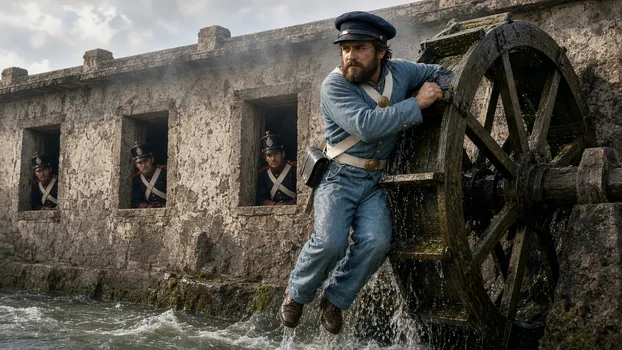
In the confusion Brandon’s company got pinned against the end of the building near the race, and Brandon looked up at the wheel. The door above him was barred. The windows were full of muskets. The wheel was turning. He waded into the race, grabbed a paddle at the bottom as it came around, and was lifted gently out of the water toward the sky.
It is fair to say the plan had a flaw. A water wheel does not stop at the top. Brandon rose past the windows, where several Mexican soldiers stared at him, came up level with the roof, reached for the edge, missed, and went smoothly over the top and down the other side into the race. He came up spitting, without his cap. The wheel brought around another paddle. He took it.
The second time he got a hand on the roof tiles and lost it. The third time he got both hands on the roof and kept his feet on the paddle, and for a moment he was stretched between them like a man being measured for a coat, until the wheel won. By now the Mexican soldiers at the windows had stopped shooting at him, partly from confusion and partly because they wanted to see how it came out. One of them was keeping count. The Kentucky private, watching from behind a cart, was keeping count too, and offered the man in the window a bet.
On the fourth time around, Brandon let go of the paddle at exactly the top and fell onto the roof of the Molino del Rey, face down, soaking wet and dizzy. He lay there for a while. When he stood up, he found that he was not alone.
On the roof were a Mexican major and five or six other officers and a number of men, cut off when the attack came through the building beneath them and unable to get down. They still had their swords and muskets. They had been watching the edge of the roof for American soldiers coming up a ladder. They had not been watching it for a dripping American coming up on a mill wheel, four times, and they were not certain what they had seen.
Brandon was not certain what to do either. He had no musket; it was in the race. He had a bayonet in his belt and the confidence of a man who had been a friar until Sunday. So he did the only military thing he could think of. He picked up a loose musket, put it on his shoulder, and began to walk back and forth across the roof as a sentry, in front of all of them, with the calm of a man who had been ordered there and expected his relief at any time.
Nobody stopped him. Nobody had ever seen a sentry arrive by water wheel before, and it seemed rude to interrupt one.
A little later a young lieutenant of the 4th Infantry, the regiment’s quartermaster, looked at the mill and saw no stairway or ladder to the roof. He had a cart brought up, pushed its shafts against the wall, chocked the wheels, and climbed the shafts like a ladder, with a few men behind him. His name was Ulysses S. Grant. Years later he wrote about it in his Memoirs, and what follows is his own wording.
He climbed to the roof, he wrote, “followed by a few men, but found a private soldier had preceded me by some other way.” On the roof were still “quite a number of Mexicans,” among them “a major and five or six officers of lower grades.” They still had their arms, “while the soldier before mentioned was walking as sentry, guarding the prisoners he had surrounded, all by himself.” Grant halted the sentinel, received the swords from the officers, and had the muskets broken against the edge of the wall and thrown to the ground below.
Grant wrote that a private had got there by some other way. The other way had taken Brandon Herrera around four times.
Grant never named him. This story does not claim to know who that private really was; Grant tells us only that he existed and that he was alone. Brandon, who did not know he was in a future president’s memoir, handed over his borrowed musket, saluted the lieutenant, and asked politely whether there was a dry way down.
On the ground the battle went on. Brigades under Garland, Clarke and Cadwalader pressed into the mill and around the Casa Mata. General León was mortally wounded, and Colonel Lucas Balderas fell leading his National Guard battalion. Álvarez’s cavalry never made a full charge. Sometime after the defenders fell back, the Casa Mata blew up. In about two hours the fighting was over, and the mill was Worth’s.
Then the Americans searched it for the cannon foundry. They found a few old gun molds. There was no foundry.
It was one of the costliest days of the war for the United States Army. American losses were 116 killed and 671 wounded, roughly a quarter of the force engaged. Mexican losses were about 269 killed and about 500 wounded, with between 685 and 852 taken prisoner, depending on the count. Worth pulled his men back from the mill, which Scott did not try to hold. The only lasting result was to bring the army closer to Chapultepec, which it stormed five days later, and to make many of its officers angry for the rest of their lives about the morning they spent buying a building for a rumor.
Brandon’s company commander heard the story from the Kentucky private, who told it at supper with sound effects, including the wheel. He did not put it in any report, because Lieutenant Grant had already reported the private on the roof and had been very properly modest about the details. But he did write an order in the company book that afternoon: “Pvt. Herrera, having stood a sentry’s watch over a major, five or six officers and sundry men, unrelieved, under arms, on a roof, is excused from guard duty for thirty days, it being the opinion of his captain that he has done a month’s worth in one morning.”
Brandon slept that night under a cart. Not the one Grant had used. He had looked at that one and decided, for the first time in his life, that he did not need to know where it went.