Brandon Herrera and the Stolen Bells
Have you ever watched a private try to steal a charge with other men's cowbells and the modest hope that a lancer would rather chase a herd that was not there than finish the one that was?
On a wet December morning in the valley of San Pasqual, General Stephen Kearny's worn-out column came off the ridge looking for a surprise and found one already in the saddle. What no one in that gray light expected was that one soldier with a packer's ear would lift the bells off village stock and make a whole file of Californios hunt cattle that had already gone to breakfast.
By the summer of 1846 the war that had opened on the Rio Grande had a second door, a thousand miles west. Brigadier General Stephen Watts Kearny left Fort Leavenworth with the Army of the West, took Santa Fe on the eighteenth of August without firing a shot, and proclaimed New Mexico American ground. He left most of his strength to hold it. With about a hundred men of the 1st Dragoons, two mountain howitzers, and a thin string of volunteers, he turned for California. On the Gila he met Kit Carson riding east with the news that Commodore Stockton and Lieutenant Colonel Frémont already held the ports. Kearny cut his escort again and pushed on across the desert, certain the work was finished. It was not. The Californios had risen, driven the small American garrisons from Los Angeles, and put Andrés Pico in the field with men who could ride and throw a lance. On the second of December Kearny reached Warner's Ranch. On the fifth, Captain Archibald Gillespie came out from San Diego with a handful of volunteers and a warning. Pico was close. The powder was wet from a night of rain. The best horses had been used up on the long march. Most of the dragoons sat on tired mules.
Kearny would not wait. Before dawn on the sixth he sent Captain Abraham Johnston forward with twelve men on the soundest mounts, then Captain Benjamin Moore with about fifty dragoons, then Gillespie's volunteers, then the howitzers under Lieutenant Davidson. Brandon Herrera was with the gun mules, a private of the 1st Dragoons whose job that morning was to keep two stubborn animals and a pair of drag ropes from wandering into a fight they were not built for.
Johnston struck first in the half light. A Californio escopeta flashed from the village side. Johnston went down dead. The advance piled into Pico's men before the rest of the column had even seen the valley floor. Fresh horses met worn mules. Long lances met wet carbines that would not fire. Moore's troop went in at a ragged gallop and came apart in a melee no drill book had described. Men were yanked from the saddle, hog-tied in the mud, and worked over with the point. Kearny took two wounds. Gillespie took three. Moore was lanced and died. Lieutenant Hammond was lanced and lived only a few hours. One howitzer team bolted. The mules tore loose and ran the piece straight into Pico's riders, who threw a reata on it and hauled it off as a prize.
The first rush burned out as fast as it had started. Pico pulled his men back to the far swell to dress ranks and come again. The Americans held a scrap of wet field and a pile of their own dead. Carbines still hung fire. The remaining howitzer was not yet unlimbered. Brandon, on foot now beside a panting mule, looked left of the line, where the Kumeyaay village and a scatter of rancho stock had been before the shooting started, and heard what the valley still had to offer.
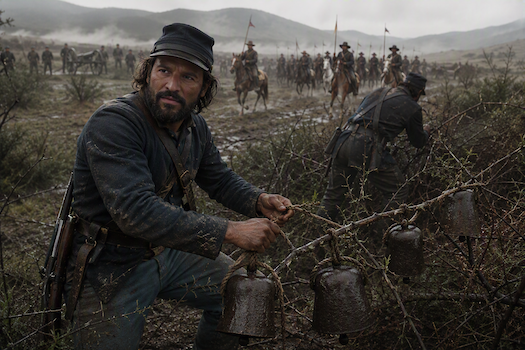
Bells. Not many. The dull iron notes of cattle that had been loosed or abandoned when the village emptied. Two hung on a brush fence. Three more lay in the mud where a boy had cut them off rather than leave a mark for either army. They were the ordinary bells of a California rancho, meant to tell a rider where his stock had wandered in the fog, not to tell a general where to send a file of lancers. "If they will hunt a noise," Brandon told the two privates nearest him, "we shall give them a better one than we have."
They worked in the few minutes Pico allowed them. Brandon and the two men scooped the bells, cut spare thong from a pack frame, and ran low into a brush draw off the American left, a cattle path that fell away toward empty pasture and a dry wash. They hung the bells on the limbs at different heights, some close enough to kiss in a breath of wind, some on longer thongs so a man could start them by hand. Brandon kept one thong in his fist. A private stayed with him. The third man went back to shout if Pico moved. "They stole a gun with a rope," Brandon said. "We shall steal a file with a dinner bell. Fair trade, and no receipt."
Pico came on again, not in a thin probe this time but in a proper lancer rush, points down, the wet valley throwing up clods. At the same heartbeat Brandon and the private worked the thongs. The draw woke up like a small herd changing ground in a hurry, iron on iron, the sound skipping off the brush and down the wash as if twenty head had broken for the next canyon. On a wet morning, with powder sulking and men shouting in two languages, that noise was as good as a map.
A file on Pico's right heard it and believed it. Ranch men live by bells. A herd on the move in the middle of a fight is either loot or a flank they did not plan for. The file peeled toward the draw. The center, suddenly thinner, still hit the American scrap of field, but the weight that should have finished the howitzer team went hunting cattle that were not there. Lances that had been aimed at dragoon chests poked at empty brush. A rider cursed the stock. Another tried to turn back and fouled the man behind him. Brandon, flat in the wash with the last thong in his fingers, muttered, "Aye, that is the step. Now try milking them."
The remaining howitzer, which had been useless in the first five minutes, finally got its muzzle around. A round of canister into the thinner rush was enough. Pico's men who were still up did what good horsemen do when half their friends have ridden off after breakfast. They broke off, gathered the ones they could lift, and quit the field. They took their wounded with them and left six of their own who could not be moved. They also left the stolen howitzer behind in the confusion, its trail sunk in the same grass the missing file should have covered.
The Americans occupied the ground because there was no one left on it who wanted it. That was the whole of the victory. Eighteen of Kearny's men were dead on the field or would be dead before the surgeons were done, among them Johnston, Moore, and Hammond. About thirteen more were wounded, some with two lance holes, some with ten. Kearny himself could barely sit a saddle. Pico later reported one man killed and fourteen wounded. Other American counts put the Californio loss a little higher. Either way the arithmetic was ugly. A column that had walked from Missouri to take a province without a fight had been cut to pieces in half an hour by men who knew the valley and the lance.
They buried the dead in a common grave as the rain started again. On the seventh they moved, wounded in crude ambulances made of poles and hide, toward San Diego, and found Pico waiting on the hills. At a rise the men named Mule Hill they dug in among the rocks, dug for water in the sand below, and waited. The ration that night was the same animal that had carried a man that morning. Carbines were dried as best as wet rags would allow. Pico's riders showed themselves on the next crest and did not come in. On the night of the eighth, Carson, Lieutenant Edward Beale, and an Indian guide slipped off the hill, pulled off their boots so the scree would not talk, and crawled through three lines of mounted sentries. They walked the rest of the way barefoot over prickly pear. Stockton, when they reached him, sent sailors and Marines with dry powder and beef. The relief came up on the eleventh. Pico withdrew rather than fight a fresh column. Kearny's remnant limped into San Diego on the twelfth.
San Pasqual did not decide California by itself. Kearny had already taken New Mexico. Stockton and Frémont had already taken the ports once and lost Los Angeles. What the morning in the valley did was prove that the province was not finished business, and that a handful of ranch lancers could still maul a regular column if the column arrived half starved and half wet. In January, Kearny and Stockton crossed the San Gabriel together, fought again at La Mesa, and entered Los Angeles. On the thirteenth of January, Pico signed the Treaty of Cahuenga with Frémont. California passed, in fact if not yet on paper, to the United States. The west coast was no longer a rumor in a Washington dispatch. It was a second theater the Republic now had to hold, and the butcher's bill for that first wet morning was the price of learning it.
Two days after the column reached San Diego, Kearny had what was left of the escort formed in the yard of the hide house that passed for quarters. An adjutant read a short line from the dispatch that would go east, naming Private Brandon Herrera for "ingenious use of village bells, by which a file of the enemy was drawn from the gun and the remaining piece preserved to the command." The general, still stiff from the lance, then had a captured Californio lance brought forward, a plain wooden shaft with an iron head dark from the field, and put it in Brandon's hands as a mark of the Army of the West's notice, distinct from any later certificate. Brandon took it without a speech. To the private who had worked the far thongs he said only, "A man who lives by the bell ought to know when it is lying. I shall keep that in my pocket, in case the next herd forgets."
The valley kept its wet grass. The bells went back to the stock, or as near as a soldier would let them. San Diego had a harbor and a flag. Los Angeles was still ahead. The war in the west had drawn blood at last, and the private who had stolen the bells was, for one morning, the reason a second charge did not finish what the first one started.