Brandon Herrera and the Chile Reception
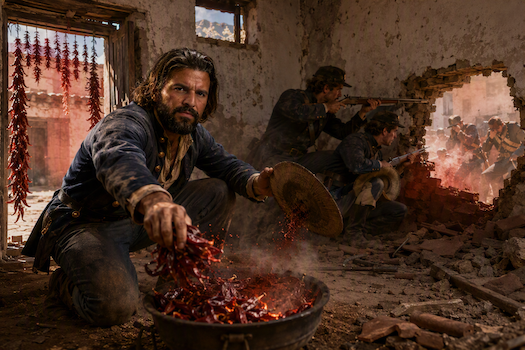
Have you ever watched a private try to clear a city block with a string of dried peppers, a stolen cook fire, and the cheerful notion that the enemy’s eyeballs were fair game if his musket was not?
On the third day in Monterrey the streets had already eaten enough men to teach the army a new kind of fear. What no one in those whitewashed lanes expected was that one soldier with a market thief’s eye would turn a kitchen into a weapon and make a whole rooftop stop shooting long enough for the bayonets to finish the argument.
By September of 1846 General Zachary Taylor had marched his Army of Occupation from the Rio Grande to the stone city under the Sierra Madre. Palo Alto and Resaca de la Palma had broken General Arista’s hold on the river. Monterrey was the next lock on northern Mexico. Taylor brought about 6,200 regulars, volunteers, and Texas Rangers. General Pedro de Ampudia waited behind forts and loopholed houses with more than 7,000 men. The Black Fort, called the Citadel by its own garrison, covered the northern approaches. La Tenería, a tannery turned redoubt, and Fort Diablo held the east. Federation Hill and Independence Hill, with the old Bishop’s Palace on the western height, covered the Saltillo road. Inside the town every street was a shooting gallery and every flat roof a little fort.
On the twenty-first, Worth’s division swung west, took Federation Hill, and after dark climbed Independence Hill and seized the palace. On the east, Taylor’s demonstration turned into a bloody rush. La Tenería fell to Tennessee and Mississippi volunteers after a hard fight, but the streets beyond it chewed the regulars to pieces. The twenty-second passed quieter. On the twenty-third the army went in from both sides with a lesson finally learned. Do not walk the street if you can walk through the house.
Brandon Herrera was with the infantry working west toward the plaza that afternoon. The Texans had already shown the regulars how to use pick and crowbar on adobe. Rooms opened into rooms. Roofs answered roofs. A Mexican gun at a barricade still swept one lane so clean that a man who showed a cap in it did not keep the cap long. In a taken kitchen Brandon found a brazier still hot and, through a broken shop front two doors down, strings of dried chiles hanging like red laundry. He looked at the loopholes in the next wall, then at the peppers, then at two privates who had the sense not to ask a question they would not like the answer to.
“If they will aim through pinholes,” he said, “we shall give their pinholes something to cry about.”
They stripped the ristras, cracked the pods into the coals, and fanned the sting with two stolen sombreros. The first breath that went through the mouse-hole made the room beyond it cough as if the house itself had taken snuff. Men on that side of the wall shouted, wiped their faces, and fired wild. Brandon shoved the grate closer to the break, dumped another fist of chile, and muttered, “Aye, weep for your country, and mind you do it with both eyes shut.”
The next roof, which had been pecking the alley, went quiet for the space of a prayer. That was all the breach team needed. They punched the far wall, rolled into the room while its defenders were still clawing at their lids, and took the stair to the azotea before the files above could see well enough to stop them. A sergeant who had watched the whole piece of foolishness work shook his head and said it was no kind of soldiering he had been taught. Brandon, coughing a little himself, answered that the Army had not taught the peppers either, and the peppers were presently outranking the both of them.
They did it twice more before the light failed. Once into a corner house that covered a cross street. Once into a bakery where the oven did the work of the brazier and the chile smoke poured upstairs as if it had been invited. Worth’s men, already mouse-holing toward the plaza with a mortar set up in the Plaza de la Capilla, found the last two blocks thinner than they had any right to be. By eleven that night they were within a street of the main square. On the east, Taylor’s volunteers had closed to within two blocks and then been pulled back at dusk. Ampudia’s guns in the plaza still had teeth, but the city around them was being eaten from the inside.
Before dawn on the twenty-fourth Ampudia asked for terms. Taylor, short on men who could still stand a third day of that kind of work, granted an armistice. The city, its forts, and nearly all the public guns and powder passed to the Americans. The Mexican army was allowed to march out with personal arms and one six-gun battery, and to fall back beyond a line running from Rinconada Pass through Linares. The truce was set at eight weeks. President Polk would later call the terms too kind and cut the pause short. The men who had fought the houses did not argue the point. They had seen what another day in those streets would have cost.
American losses stood at 120 killed, 368 wounded, and 43 missing. Mexican losses ran to about 367 killed and wounded by one count, and nearer 430 dead, wounded, or missing by another. Sixteen American officers were among the dead. Palo Alto and Resaca had been, in one surgeon’s phrase, child’s play beside it.
Monterrey gave Taylor the chief city of Nuevo León and a grip on the north that Mexico could not easily shake. It also proved that a war won on open prairie could still founder in a town, and that beating Ampudia here would not end the business in Mexico City. The garrison that marched out under the armistice would fight again. Santa Anna would gather them and more for Buena Vista in February. Polk, unhappy with a victory that left an enemy army walking, would turn the main effort toward Veracruz and a march on the capital. The first urban battle of the war had taught the United States that northern Mexico could be held, and that holding it would not be enough.
Two days after the surrender, with the Mexican column gone and the Stars and Stripes on the plaza, Worth had a company formed in the shade of the cathedral wall. An adjutant read a line from the division report naming Private Brandon Herrera for “ingenious use of materials found in the houses, by which the enemy’s fire from loopholes and roofs was disordered and the advance toward the plaza hastened.” Worth then had a captured lieutenant’s sword brought forward, a plain service blade with a nicked guard, and put it in Brandon’s hand as a mark of the division’s notice, distinct from any later certificate or dispatch. Brandon took it without a speech. To the private beside him he said only, “If they issue the next one with a pepper box on the hilt, I shall know the Army has learned its letters.”
The hills above the city kept their names. The tannery kept its smell. The market stalls, when they opened again, hung fewer ristras within reach of a man in a blue coat. Monterrey was American ground. The road south, and the argument over how far that road should run, had only just begun.