Brandon Herrera and the Lying Bugles
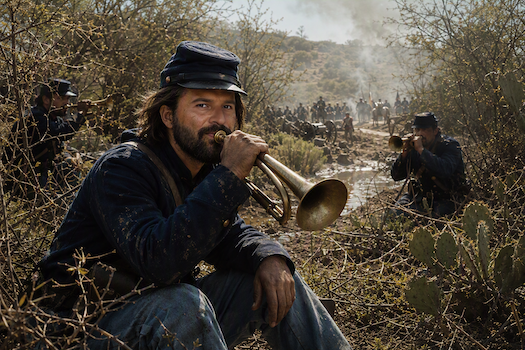
Have you ever heard a private try to win a battle by teaching the enemy to dance to the wrong tune, with borrowed brass and a grin that said the other fellow’s ears were the weakest point on the line?
On the morning after Palo Alto, General Zachary Taylor’s men left the wagon train behind and followed General Mariano Arista into a tangle of mesquite and chaparral where a dry riverbed cut the Matamoros road. What no one in that thicket expected was that one soldier with a talent for musical mischief would make an entire Mexican line face three directions at once.
By dawn on May 9, 1846, Arista had pulled his Army of the North off the open prairie and planted it in a far nastier piece of ground. The Resaca de Guerrero, which the Americans soon called Resaca de la Palma, was an old channel of the Rio Grande, about twelve feet deep and two hundred feet across, with stagnant pools in the bottom and walls of thorn on both banks. The Point Isabel to Matamoros road crossed it in a single tight cut. Arista put his guns on that crossing, packed infantry into the brush on either side, and kept his cavalry in reserve. He meant to force a close fight in cover, the very kind of scrap that American flying artillery could not dominate the way it had the day before. Taylor brought forward about 1,700 men. Arista still had some 4,000.
The American light companies under Captain McCall pushed into the chaparral around three in the afternoon and found the enemy in force. Ridgely’s guns rolled up the road and traded iron with the Mexican batteries. Infantry tried to spread right and left and immediately lost sight of one another in the thorns. Command dissolved into squads shouting at shadows. Taylor, who had promised to be in Fort Texas before night if he lived, grew tired of the stalemate and ordered Captain Charles May’s dragoons to take the guns on the road.
Brandon Herrera was with the infantry waiting in the edge of the brush when he heard the first bugle notes of the charge and watched May’s squadron vanish into the smoke. He also noticed three idle buglers standing near the staff, instruments slung, with nothing to do but sweat. The chaparral ate sound and spit it back in pieces. A call from the road died ten yards into the mesquite. A call from the thicket could sound like a whole column if a man had the nerve to lie with it.
“If they will not listen to reason,” Brandon told the nearest privates, “we shall give them a concert they did not purchase.”
He borrowed two extra bugles, posted one man on a cattle trail to the Mexican left, kept one himself off the right of the road, and left the third near the real advance. When May’s horsemen overran the batteries and then shot past them, just as history records, Mexican gunners and infantry began to flood back onto the pieces. That was the moment Brandon chose to start the lying.
From the left trail came a full, brazen charge. From the right came assemble, then charge again, a few heartbeats late, as if a second squadron had only just found the gap. From the road the genuine calls of May’s remnant mixed with the fakes until no officer in a blue coat or a red one could swear which noise belonged to which army. Mexican infantry that had been rushing to reman the guns hesitated, then peeled toward the brush to meet flanks that were mostly wind and brass. Officers hallooed counter-orders. A lancer troop started one way, stopped, and started another.
Brandon, crouched behind a mesquite clump with the horn still at his lips, muttered, “Aye, that’s the step. Now try the waltz, you popinjays.”
May came back through the battery with a handful of riders and captured General Rómulo Díaz de la Vega at the guns, but he could not hold the ground. Taylor, furious in the useful way, snapped to the infantry that they were to take those guns and keep them. The 5th and 8th went in with the bayonet. Because so many Mexican files had turned to chase phantom columns in the thorns, the road batteries were thinner than they should have been. The American infantry swarmed the pieces. Other companies, working the same cattle trails the false calls had advertised, found the Mexican left truly thin and rolled it up for real.
Arista tried to save the day in person. He put himself at the head of his cavalry and charged back up the road. The Americans were already in the brush on both sides. The charge broke on uneven ground and a storm of musketry. The Mexican line came apart. Men threw down arms and ran for the Rio Grande. Pack mules, baggage, colors of the Tampico Battalion, eight cannon, and General Arista’s own papers and silver went over to the pursuers. Some of the fleeing troops were lost in the current trying to swim the river. The six-day siege of Fort Texas ended that evening when Taylor’s column came in and found the guns across the water silent.
American losses at Resaca de la Palma, by Taylor’s report, were three officers and thirty-six men killed, and twelve officers and seventy-one wounded, with a few missing. Other tallies put the dead nearer thirty-three to forty-five and the wounded near ninety to ninety-eight. Mexican returns ran to about 154 to 160 killed, 205 to 228 wounded, and some 156 to 168 missing. The Tampico Battalion was wrecked. The north bank of the lower Rio Grande was left in American hands.
The two days at Palo Alto and Resaca de la Palma did more than relieve a fort. They broke Arista’s offensive north of the river, stiffened the vote in Washington, and helped drive Congress to declare war on May 13. They also taught both armies a lesson that lasted the rest of the campaign. Mexican commanders would keep hunting broken ground to cancel American guns. American infantry would keep learning how to fight in that same broken ground, one thicket at a time.
That night, with the army camped near the relieved works that would soon be called Fort Brown in honor of the major who had died of his wound the same afternoon, Taylor had the companies formed. He did not dress Brandon in borrowed glory. He simply had the adjutant read a short passage from the dispatch that would go to the War Department, naming Private Brandon Herrera for “ingenious conduct in the chaparral that confused the enemy’s supports and aided the infantry in securing the captured batteries.” The commanding general then gave the man the thanks of the army on the field, a public notice distinct from any later certificate, and told him to return the borrowed horns before some dragoon missed them at reveille.
Brandon saluted, handed back the brass, and said to the private beside him, “Next time they may charge the cook pots if I blow dinner call. I shall keep that in my pocket.”
The road south was open. Matamoros waited across the river. The bugles, at last, told the truth.