Have you ever watched Brandon Herrera try to hold a ranch gate against a column of lancers with the house jars and a well rope, on the plain theory that a horse will think twice about a floor it cannot see?
On the morning of February 23, 1847, the American baggage train sat in the clay yard of the hacienda of Buena Vista with the mountain at its back and Mexican cavalry coming for the stores. What no one at that depot expected was that a wagoner would issue the drinking water all at once, by the jar, and call the mess a defense.
The war had been running since the Rio Grande fights of the year before. General Zachary Taylor had taken Monterrey in September and pushed on to Saltillo. President Polk then pulled Taylor's best regulars south for General Winfield Scott's coming stroke at Veracruz. What Taylor had left, under Brigadier General John E. Wool, was a short army of volunteers, about 4,700 men, and a handful of guns. General Antonio Lopez de Santa Anna marched north from San Luis Potosi with something near 15,000 men who had already buried or lost thousands on the desert road. Taylor fell back from Agua Nueva to a place the Mexicans called La Angostura, the narrows, a mile and a quarter south of the hacienda San Juan de la Buena Vista. The Saltillo road ran there through a pass between high ground. Ravines cut the plateau on the east. Arroyos cut the west. Wool liked it because a big army would have to come on in pieces.
Santa Anna's horsemen found the Americans on the morning of February 22. There was a summons to give up the position. Taylor did not. Skirmishing died with the light. In the dark a Mexican battery was hauled onto the high ground above the American left. The night was cold. The plateau wind worried every loose canvas on the train. Brandon Herrera spent it with the wagons at the hacienda, a private detailed as wagoner, whose work was water, spare powder, and the sorry job of keeping teamsters from treating a sheep ranch like a sutler's holiday.
The hacienda was a poor place to be rich in. Flat clay roofs. A corral. A well with a wooden sweep. The train and the baggage had been parked in the yard because the fighting line at the narrows had no room for them. Wounded from the evening brush already lay under a shed. The spare ammunition chests sat on the wagon beds with the lids down. The only good water for that end of the position was the well, and the ranch kept it the way a dry plateau keeps anything worth having, in big clay ollas ranged along the gallery wall, each jar as high as a man's ribs and heavy enough that two men cursed it when they moved it.
February 23 came up clear and hard. The Mexican attack went in against the American left, where the plateau opened and the ravines gave a foot to any man willing to climb. The 2nd Indiana, out on that flank with the 2nd Illinois and a section of guns, took the weight of it. The Hoosiers stood until the fire and the numbers tore the formation, and then a part of them broke. Mexican cavalry under General Julian Juvera poured through the gap and swung for the hacienda. Taylor's report later put it plain. A large body of the enemy concentrated on the extreme left with a view to a descent on Buena Vista, where the train and baggage were deposited.
Brandon heard them before he saw them. A low drum of hooves on the salt grass east of the corral, and the thin cry of a trumpet that was not American. Sergeant Elam of the train came off a wagon tongue with his hat in his fist. "Lancers," Elam said. "They're not coming for the narrows. They're coming here."
Major John Munroe, chief of artillery, was already in the yard trying to make a line out of rallied Indiana men, teamsters, and whoever had a musket and had not run for Saltillo. Lieutenant Colonel May had been sent with two of Captain Thomas Sherman's guns under Lieutenant Reynolds, but the guns were not in the gate yet. The Kentucky and Arkansas horse were out on the grass and about to be hit themselves. Colonel Archibald Yell would die in that melee. None of that helped the yard in the next two minutes.
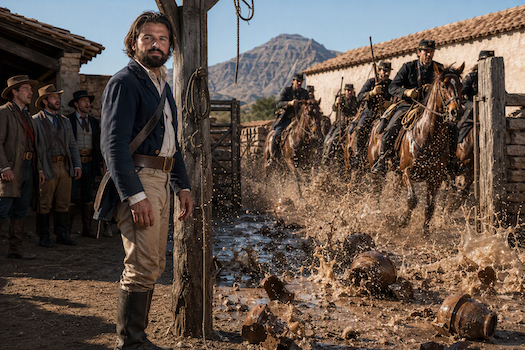
The bind was the gate and the short slope that fed it. The packed trail came off the plateau, pinched between the corral wall and a clay outbuilding, and opened into the yard where the powder wagons stood. If the lancers got through that throat they would be among the chests, the wounded, and the only water. A wagoner with a musket could kill a horse. He could not stop a column.
Brandon looked at the gallery. The ollas were still there, a row of them, beaded with last night's chill. The well rope was new enough to trust, ixtle fiber, thick as a thumb, coiled on the sweep. The slope above the trail was the same clay the jars were made of. Dry, it was dust. Wet, it was grease without a drop of oil in it. "Elam," he said. "Get two men and the spare trace chains. We're going to move the drinking water." "Into the wagons?" Elam asked. "Onto the trail," Brandon said. "If they want the stores, they can have a bath on the way in."
They had less time than the sentence took. Brandon and Elam rolled the first olla off the gallery onto a wagon sheet. The jar grumbled on the clay. A second. A third. A fourth. Teamsters who had been looking for a place to hide took hold because a jar is a thing a man understands. They dragged four of the great jars up the short rise beside the trail, just above the pinch, and set them on their bellies with the mouths uphill so they would not walk off early. Brandon ran the well rope through the handles and through the trace chains, made a single bight, and belayed it to the corral post at the top of the slope. One hard pull would take the slack. The jars would go together.
He sent a boy with a bucket brigade to the well, not to fill anything new, but to wet the dust in a ribbon across the pinch. A skin of water on that clay was enough to start it. The rest would come from the jars. "Keep off the rope," he told the Indiana men Munroe was shoving into the shed shadow. "When I cut the hitch, the trail's for the jars. After that it's yours." A lieutenant with a torn cuff stared at the rope. "You're going to fight cavalry with crockery." "I'm going to change the floor," Brandon said. "You can shoot whatever's still upright."
The first Mexican riders came around the corral at a lope, lances dressed, the front rank already choosing the gate. They had ridden since the break on the left. The hacienda looked soft. No guns in the throat yet. A few muskets at the shed. A line of idiots hauling jars.
Brandon waited until the lead horses entered the pinch and the dust of the column was committed. Then he cut the hitch.
The rope sang. The four ollas rolled. They did not bounce like barrels and they did not run like wheels. They turned once, heavy and sullen, and broke on the packed trail in the same breath. Clay went in sheets. Water went in a wall as high as a stirrup, then flattened and ran under the hooves. The wet ribbon he had laid took the flood and turned the pinch into a skin of adobe slick over a hard pan. The lead horses sat down as if the ground had been pulled out from under the morning. One went onto its shoulder. A second struck the burst belly of a jar and tried to climb it. The riders behind could not stop. The column accordioned into the gate. Lances that had been a straight thicket became a pile of sticks. A horse screamed. A man in a blue jacket with silver on the cuff went off over the neck and came up spitting clay.
That was the comic peak, if a man could call it comic while a lance head was still looking for him. From the shed it had a mean kind of beauty. An attack that had come in at a gallop was suddenly a crowd at a washing place, sliding, swearing, and striking one another with the shafts they could not dress. The rallied Indiana men fired into the knot because Brandon had told them the trail was theirs after the jars. The volley was ragged and close. It was enough. The head of the column sheared away toward the mountain, which is what Taylor's report said that portion did, under the fire from the yard and then from Reynolds's section as May's horsemen came up. The rest of Juvera's riders were already in trouble farther out, where the Kentucky and Arkansas men and a handful of dragoons broke the column into pieces.
It was not free. The third jar burst early, short of the pinch, and soaked the nearest ammunition chest. Elam and Brandon rolled that chest behind the corral and wrote it off. A lancer on the ground, more angry than hurt, put his point through the meat of a teamster's arm before an Indiana private clubbed him with a musket. The wet clay did not care whose wheels it caught. A caisson team coming in with Reynolds hit the same ribbon and mired to the fetlocks. The gunners unhitched under their own fire and ran the piece the last yards by hand. Brandon took a shard across the knuckles and did not notice until the rope burn made itself known.
By the time the yard was quiet enough to hear the well sweep creak, the depot still held. The wounded were still under the shed. The dry chests were still dry. Munroe's scratch line had a gate to stand in instead of a rout to join. Out on the plateau the larger fight went on. Jefferson Davis put the Mississippi rifles and the rallied volunteers into a V and met the horsemen who had swept past. Later in the day Santa Anna threw a fresh column at the narrows. Braxton Bragg's guns met it with canister, double-shotted, and a cold rain came down on the plateau and turned every ravine mean. The Mexicans did not break the pass. In the night Santa Anna drew off toward Agua Nueva and left his fires burning so the American pickets would think the host was still there.
The bill was ugly on both sides. American returns for the two days ran to 267 killed, 387 wounded, and 6 missing. Mexican counts ran to 591 killed, 1,048 wounded, and nearly 1,900 missing, with the missing swollen by men who had already been used up on the desert march. Both generals claimed the field. Taylor still held La Angostura and the Saltillo road in the morning. Santa Anna had the trophies he carried off and a march back south. It was the last great fight of the war in the north. Within the month Scott's army would be ashore at Veracruz, and Santa Anna would have to turn and meet that second door.
In the yard, with the rain starting and the broken jars looking like a kitchen after a bad saint's day, the lieutenant with the torn cuff found Brandon sitting on the corral wall wrapping his hand. "You expended the water," the lieutenant said. "I issued it," Brandon said. "Tell the general the ration was generous. I wouldn't say the gentlemen got to drink it standing up."
Wool's field note on the depot fight, copied into the division papers, named Private Brandon Herrera of the train for ingenious use of the hacienda water jars in holding the gate until the guns came. The rallied Indiana men, who had a sense of humor once they stopped running, presented him a pair of captured Mexican spurs as the depot's notice. The quartermaster then put him on the list for extra fatigue for destroying government water stores without a requisition. Wool struck the fatigue out and left the sentence about the jars in. A man could ride farther on a line in a report than he could on another man's spurs, but Brandon kept the spurs anyway. "The well can be drawn again," he said. "A gate that's already burst once doesn't need to prove the point twice."