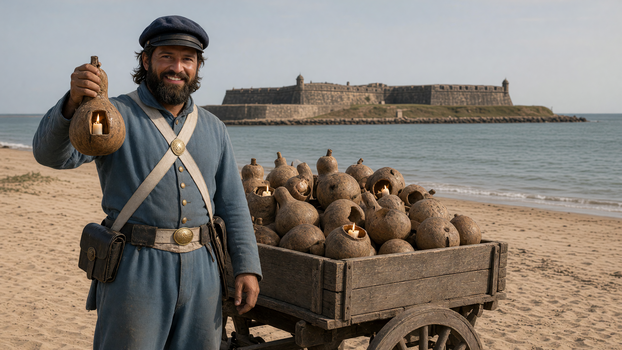
Have you ever watched a private try to sink a fortress's patience with a fleet made of supper squash?
In March of 1847 the Gulf coast of Mexico was a long white beach, a walled port called Veracruz, and out on its reef the island fort of San Juan de Ulúa, gray and patient and bristling with iron. What no one on either side of that water expected was that one soldier with a knack for lamps would put to sea without a ship, a sailor, or anything heavier than a candle.
General Winfield Scott had come to open a second door into Mexico, and Commodore David Conner's squadron had carried him to it. Scott brought about 8,600 men. Brigadier General Juan Esteban Morales held the city with 3,360. General José Durán held Ulúa with 135 guns. Scott was racing two enemies who wore no uniform. One was the norther, a gale that could blow down out of a clear sky and stop a landing for days. The other was the vomito, yellow fever, which the coast kept for strangers once the spring turned hot. Scott meant to be up in the highlands before it came.
On March 9 the army went ashore at Collado Beach, a few miles south of the city, opposite Sacrificios island. Some accounts call the place Mocambo Bay. About 65 surfboats, rowed by naval crews, carried the first line in while steamers and gunboats lay in grape range of the sand. General William Worth jumped ashore first. Ulúa fired, loudly, though in vain. By nightfall the whole force was on the beach, and not a man had been lost. Then a norther came and buried the camp in sand, as if the coast meant to file a complaint. By March 13 the siege line ran about seven miles around the city, and the water was cut.
Brandon Herrera was with the infantry on the dunes near the water, where a man could see the castle every evening and the castle could see nothing but him. Each night the sentries watched Ulúa's gunners fire at anything that moved or glowed on the harbor. A lantern on a boat drew a shot. A fisherman's light drew two. Brandon studied this the way other men studied cards.
A seized market cart had yielded a heap of dried gourds, light as cork and round as a quartermaster. Somebody had candle stubs. A few privates watched him hollow the first gourd with a bayonet. "That's the commissary's supper you're gutting," said one of them, a long Ohio boy who disapproved of everything. "It was supper," Brandon said. "It's now the navy. If they'll fire at every light upon the water, we'll give them a navy to quarrel with." "You're a ninnyhammer," the Ohio boy said, and helped anyway.
They waited for a calm night. It came somewhere between the closing of the line and the opening of the guns. The privates cut a window in each gourd on the seaward side and left the shoreward side blind, so the castle would see the flame and the beach would not. Into each went a candle stub, set in sand to keep it upright. Brandon walked them out to the edge of the surf, where the set ran off toward the reef, and launched them one by one, in rough line abreast, like a commodore with a grudge.
From the dunes it looked like a squadron creeping in under shaded lanterns. From Ulúa it must have looked like the same thing, because the castle opened on it.
The first shot threw up a column of water well wide of the nearest gourd. The second did better and hit the sea. The gourds did not return fire. They did not change course. They bobbed with a dignity no real frigate ever managed, and the castle, which could not abide being ignored, fired again. "Aye, that's the spirit," Brandon muttered from behind a dune. "Shoot the pumpkin, never the frigate. Go on, you powder-wasting popinjays. Admiral Squash hasn't yet struck his colors."
The Ohio boy lay beside him with his face in the sand to keep from laughing out loud. "They'll court martial us for wasting candles." "They'll court martial the castle," Brandon said. "Listen to those coxcombs. Not a poltroon among them, and not a marksman either."
For a long stretch Ulúa's gunners worked their pieces against empty water. Now and then a gourd went out, and the guns would pause, as if in mourning, until the next light came round the swell. A sergeant came down the dune to find out who had started a naval battle without the Navy. He looked at the lights, the splashes, and the grinning privates, and said the only thing a sergeant can say in such a moment. "Which of you jackanapes is responsible for this?" Every finger pointed at Brandon. Brandon pointed at the sea.
None of it moved the siege a single day. The real battle came on just as history records. On March 22 General Morales refused Scott's summons to surrender, and at 4:15 that afternoon the American batteries opened on the city. Six heavy naval guns, landed from the squadron and worked by sailors, went into a battery sited by Captain Robert E. Lee about 700 or 800 yards from the wall, depending on which account you trust. It opened on March 24. Then a norther rose during the bombardment and wrecked about thirty vessels on the coast by moonlight, real ships with real crews, while the gourds of the week before had floated through Ulúa's whole temper without a scratch.
On March 25 a request to let women and children leave the city was refused. That night Morales resigned his command, and General José Juan Landero took it up. A truce came at 8 in the morning on March 26. The terms were settled on March 27.
On March 29 the city and the castle of San Juan de Ulúa surrendered together, and the American flag went up over Ulúa that day. The siege had lasted twenty days from the landing. American losses were about 13 killed and 55 wounded. Mexican military dead were 80 by one count and 350 by another, and about 3,000 were made prisoner. The civilians of Veracruz paid most heavily of all. Their dead ran in the hundreds by some counts and far higher by others, and no number settles it.
The port was open. Scott turned the army inland on the road toward Jalapa, uphill and away from the fever coast, and the next fight was already waiting at Cerro Gordo.
A few days after the surrender a naval officer's note found its way to General Worth's staff. In its best official manner it reported that a private's illuminations upon the water had drawn the castle's fire to no purpose on a night before the bombardment, and that the squadron was obliged to him for the entertainment. Worth's staff had a captured spyglass on hand, a good brass one, and somebody decided a man who could see a navy in a vegetable cart deserved a proper glass to look for the real one. It was handed over with no ceremony beyond a dry remark, distinct from any later certificate, and Brandon accepted it like a man receiving a sword.
The Ohio boy was not impressed. "They gave a ninnyhammer a telescope." "They gave an admiral a telescope," Brandon said, polishing the brass on his sleeve. He put the glass to his eye and found the squadron riding at anchor, every gun quiet. "Not one of them," he said, "drew half the fire mine did."
The reef kept its castle. The tide kept the gourds. Somewhere off Sacrificios, a candle went out on its own.