Have you ever watched a private try to mark a mountain road with breakfast? In April of 1847 General Winfield Scott's army left the fever coast at Veracruz behind and climbed inland, up the road toward Jalapa and the cool highlands beyond. The road wound into hills and ravines, and the hills were already occupied. What no one in that column expected was that one soldier with a sack of tortillas would try to keep the United States Army from getting lost in the dark, and would very nearly lose the argument to a donkey.
General Antonio López de Santa Anna had chosen his ground with care. Near Jalapa the road ran through a narrow defile at a place called Cerro Gordo, and above it rose a steep hill called El Telégrafo, crowned with guns. Batteries covered the approaches, and the river gorge guarded the Mexican right. By one count Santa Anna held the pass with more than 8,700 men. By another he had about 12,000. Scott's strength is given anywhere from 8,700 to 12,000, depending on whose returns you trust. Brigadier General David E. Twiggs and his leading division reached the pass on April 12, took one look at the guns waiting on the road, and wisely declined to walk into them.
So the engineers went looking for another way. Lieutenant P. G. T. Beauregard judged that whoever held a lesser hill called Atalaya could turn the whole position. Captain Robert E. Lee and other officers scouted the broken country around the Mexican left, ground the defenders believed no army could cross. Lee found a way. Work parties then cut paths through it under cover of night, over chasms where, as Grant later wrote, the walls were so steep that men could barely climb them. It was daring, exhausting, careful work, and it was Lee's.
Brandon Herrera was detailed to one of those night parties. He soon learned what every man on them learned: in the dark, every ravine looks exactly like every other ravine. A path cut at midnight could not be found again at two. On the way up from the coast the commissary had bought a great stack of tortillas along the road, and a sack of them sat near the tools, smelling faintly of home.
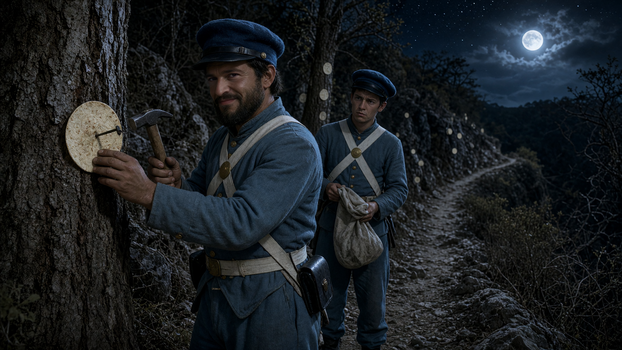
Brandon picked one up and held it toward the starlight. It was round, pale and flat, and it would take a nail. "If they'll hide a road in the dark," he told the privates beside him, "we'll leave it a trail of breakfast." "You're a lubber," said one of them, a narrow Kentucky private who had been hungry since Veracruz. "Those are for eating." He held the sack anyway.
At every turn of the new path Brandon nailed a tortilla to a tree trunk at about the height of a man's chest. In the faint light they glowed like little moons. A man coming up behind could walk from moon to moon and never step off the line. By the end of the night the trail was marked from bottom to top, and Brandon slept the sleep of a man who has improved upon the Corps of Engineers.
Morning brought birds. The birds of that country had never been offered free bread nailed at a convenient height, and they took the offer seriously. Half the markers came back pecked to lace. Worse was waiting on the lower slope near the start of the path, where the ground was still gentle enough for animals. A pack donkey had wandered off its picket in the night and found the trail, and it had eaten one whole bend of the route, turn by turn, like a man reading a book.
Brandon found the donkey chewing the last of a left-hand turn. "Aye, that one was a turn left, you thief," he told it. "You mountebank. You've eaten the Army's directions." The donkey did not apologize. Brandon ran back up and down the path, re-nailing in a hurry while the Kentucky private held the sack and counted what was left with real grief. The lesson of the morning was simple and the whole party learned it: nail them higher than a donkey can reach.
None of it changed the shape of the battle, and the real fight came on just as history records. On April 17 Twiggs's men took Atalaya and pushed toward El Telégrafo. Guns were lowered and hauled across the ravines by rope and by hand. That night, as troops filed along the paths toward the Mexican rear, a few of Brandon's surviving tortillas, at a height no donkey could reach, pointed a few files the right way in the dark. History records nothing of them, which is probably fair.
At seven in the morning on April 18, Colonel William S. Harney's brigade struck the front of El Telégrafo while Colonel Bennett C. Riley's came round its rear. The hill fell. Brigadier General Ciriaco Vásquez was killed defending it, and Captain John B. Magruder turned the captured guns on the retreat. At the same time Brigadier General James Shields's brigade, the 4th Illinois among it, came out of the woods against the Mexican camp and took the Jalapa road. Shields himself was badly wounded.
By ten in the morning the position was gone. American losses were 63 killed and 368 wounded by one count, and 64 killed and 353 wounded by another. Mexican losses ran from 1,000 to 1,200 killed and wounded, and about 3,000 men were taken prisoner, most of them later released on parole.
The road inland lay open. Scott's army entered Jalapa within days. Worth took the fortress at Perote on April 22, and Puebla was occupied on May 15. In his report Scott praised Lee's reconnaissance as "daring as laborious, and of the utmost value," and Lee was brevetted major. He had earned it.
A few days later a captain's work-party return, filed in the usual dry manner, noted among its remarks "Private Herrera, who marked the turns with provisions, until relieved of them by a donkey." Somebody at headquarters thought this worth a reward. Brandon received a fresh stack of tortillas from the commissary and the thanks of the officer, and nothing more. He took both the way other men take a promotion. He passed one tortilla to the Kentucky private, who ate it at once. "Next road," Brandon told the private beside him, "we use the donkey. At least he knows where he's been."
Down on the Jalapa road the men of the 4th Illinois had come upon Santa Anna's carriage, shot through and stopped, its mules killed. The general had escaped on a mule of his own and left nearly everything behind. There was a chicken lunch. There was a strongbox of gold. And somewhere in that wreck was the general's cork leg.
History gives the honor to the Illinois men, and does not say whose hand was first on it. This is where history lost the thread. Brandon Herrera, still following the last of his tortillas down the hill, was first to the carriage door. He reached in past the chicken and came out holding the leg of the President of Mexico.
He looked at it for a long moment. Then he handed it to the nearest Illinois man, who had a better claim to bragging about it, and asked for a drumstick instead.
The Illinois men ate the chicken. The Army got the gold. Illinois kept the leg, and it sits in Springfield still. Nobody wrote down who found it, which is probably how Brandon would have wanted it.